Saturday, November 6, 2010

My Toyota Sienna Replacement Door Handles

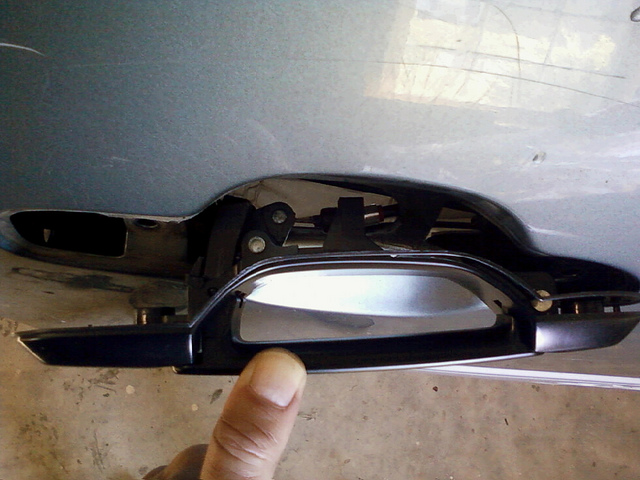
I decided to replace my own Toyota Sienna Rear Side Door Handle (Driver Side).

Broken Toyota Sienna Rear Side Door Handle.


Remove Toyota Sienna Rear inSide Door panel by removing 10mm / Phillips Head Screw from inside Toyota Sienna Rear Side Door cup holder. toyota sienna inside door panels are held on by plastic clip things that can somtimes break. use caustion when popping off your toyota sienna inside door panel.


Remove two (2) 10mm screws holding the broken Toyota Sienna Rear Side Door Handle. i used my awsome craftsmen tool set.


Line up your new Toyota Sienna Rear Side Door Handle, attach door latch cable. Re-use 10mm screws to attach the new Toyota Sienna Rear Side Door Handle.


 Then pop the toyota sienna inside door panel back on being careful to line up the toyota sienna inside door panel clips. and as Patrick from Spongebob Squarepants says, "Were Done!"


 Here is weere I ordered my Toyota Sienna Rear Side Door Handle.
Hello You sent a payment of $46.18 USD to Auto Parts Network (accounting@usautoparts.com)
Merchant
Auto Parts Network

accounting@usautoparts.com

888-872-8866
Description: Toyota Sienna Rear Side Door Handle
Unit priceQtyAmount
$46.18 USD1$46.18 USD
Subtotal$46.18 USD
Total$46.18 USD
Payment$46.18 USD
Payment sent to accounting@usautoparts.com


My next Toyota sienna door replacement handle will be purchased from amazon
I need a toyota sienna inside front door handle and Toyota front drivers side exterior door handle

.

Saturday, October 23, 2010

My Toyota Sienna Window Fogging

My Toyota Sienna air conditioning


Toyota Sienna Window Fogging
Interior fogging on the windshield can be quickly removed
by turning the mode selector to Defrost. The
Defrost/Floor mode can be used to maintain a clear
windshield and provide sufficient heating. If side window
fogging becomes a problem increase blower speed.
Toyota Sienna windows tend to fog on the inside in mild but
rainy or humid weather.

The Toyota Sienna electric Rear Window Defroster Control is
located on the climate control. Press this button to
turn on the rear window defroster. A light above the
button will illuminate when the rear window defroster is
ON. The defroster automatically turns off after approximately
15 minutes of operation for the first push of the
button, and will turn off after approximately 8 minutes
for the second push of the button.

Outside Air Intake
When operating the system, particularly during the winter
months, make sure the air intake, at the right side of
the hood, is free of ice, slush, snow, or other obstructions
such as leaves. Leaves collected in the air-intake plenum
may reduce airflow and plug the plenum water drains.

Toyota Sienna Control Setting Suggestions for Various Weather Conditions

Slight changes in your Toyota Sienna engine speed or power may be noticed
when the compressor is on. This is a normal occurrence
since the compressor will cycle on and off to maintain
comfort and increase fuel economy.
NOTE: If your air conditioning performance seems
lower than expected, check the front of the A/C condenser
for an accumulation of dirt or insects.

Recirculation Control
Air is recirculated inside the Toyota Sienna. You
may choose between Bi-Level and Panel air
outlets while in this mode. Use this mode to
temporarily block out any outside odors,
smoke, or dust and to cool the interior rapidly upon
initial start up in very hot or humid weather.

Toyota Sienna CLIMATE CONTROLS
The Air Conditioning and Heating System is designed to
make you comfortable in all types of weather.

Toyota Sienna Defog Air is directed to the
windshield, floor outlets, and
side window vents. Use this mode
to clear the windows of fog or
moisture and warm the passengers.

Toyota Sienna Defrost Air is directed to
the windshield, with some air
directed to the side window vents.
Use this mode to quickly remove fog
or frost from the windshield.
When defrost is selected, the Toyota Sienna air
conditioning turns on automatically to
improve defrosting performance. In
this mode the air conditioning cannot
be turned off and the recirculation
mode cannot be turned on.


Saturday, October 9, 2010

Your Toyota Sienna Safety Belts

Questions and Answers About your Toyota Sienna Safety Belts
Q: Will I be trapped in my Toyota Sienna after a crash if I am wearing a
safety belt?

A: You could be — whether you are wearing a safety belt or not. But
your chance of being conscious
during and after an accident, so you can unbuckle and get out, is
much greater if you are belted.
And you can unbuckle a safety belt, even if you are upside down.

Q: If my Toyota Sienna has airbags, why should I have to wear safety belts?

A: Airbags are supplemental systems only; so they work with
safety belts—not instead of them. Whether or not an airbag is provided, all occupants still have
to buckle up to get the most
protection. That is true not only in frontal collisions, but especially in
side and other collisions.

Q: If I am a good driver, and I never drive far from home,
why should I wear safety belts?

A: You may be an excellent driver, but if you are in a crash—even
one that is not your fault—you and your passenger(s) can be
hurt. Being a good driver does not
protect you from things beyond your control, such as bad drivers. Most Toyota Sienna accidents occur within
25 miles (40 km) of home. And
the greatest number of serious injuries and deaths occur at
speeds of less than 40 mph (65 km/h).
Safety belts are for everyone.

OCCUPANT RESTRAINTS
Some of the most important safety features in your
Toyota Sienna are the restraint systems:
Three-point lap and shoulder belts for all seating positions
Pretensioning and load-limiting retractors for the front seat belts
Advanced multistage driver and new active-vent front passenger airbags
An energy-absorbing steering column and steering wheel
Knee Bolsters/Blockers for front seat occupants Front seat belt retractors incorporate pretensioners to
enhance occupant protection by managing occupant If you will a feature also can be used to
hold infant and child restraint systems.

In a collision, you and your passengers can suffer
much greater injuries if you are not properly buckled up. You can strike the interior of your Toyota Sienna or other
passengers, or you can be thrown out of the vehicle. Always be sure you and others in your Toyota Sienna are
buckled up properly.

Toyota Sienna Lap/Shoulder Belt Operating Instructions
1. Enter the vehicle and close the door. Sit back and adjust the seat.

2. The seat belt latch plate is near the seatback of the
front seats and next to your arm in the rear seats. Grasp
the latch plate and pull out the belt. Slide the latch plate up the webbing as far as necessary to allow the belt to go
around your lap.

3. When the belt is long enough to fit, insert the latch plate into the buckle until you hear a “click”.

4. Position the lap belt across your thighs, below your abdomen. To remove slack in the lap belt portion, pull up
on the shoulder belt. To loosen the lap belt if it is too tight,
tilt the latch plate and pull on the lap belt.


A snug belt reduces the risk of sliding under the belt in a collision.

A belt that is buckled into the wrong buckle will
not protect you properly. The lap portion could ride too high on your body, possibly causing internal
injuries. Always buckle your belt into the buckle nearest you.
A belt that is too loose will not protect you as well. In a sudden stop you could move too far forward,
increasing the possibility of injury. Wear your seat belt snugly.

It is extremely dangerous to ride in a Toyota Sienna cargo area, inside or outside
of a vehicle. In a collision, people riding in these areas are more likely to be seriously injured or
killed. Do not allow people to ride in any area of your vehicle that is
not equipped with seats and safety belts. Be sure everyone in
your vehicle is in a seat and using a safety belt properly.

Sunday, September 26, 2010

I Keep Good Tires on my Toyota Sienna

Toyota Sienna TIRE PRESSURES
Check the inflation pressure of each tire, including the spare tire, at least monthly and
inflate to the recommended pressure for your vehicle.
The tire pressures recommended for your vehicle are found on the “Tire and Loading
Information” label located on the driver’s side door opening.

WARNING!
Overloading of your Toyota Sienna tires is dangerous. Overloading can cause tire failure, affect
vehicle handling, and increase your stopping distance. Use tires of the recommended
load capacity for your vehicle. Never overload them.
WARNING!
Improperly inflated Toyota Sienna tires are dangerous and can cause accidents. Under-inflation is
the leading cause of tire failure and may result in severe cracking, component
separation, or “blow out”. Over-inflation reduces a tire’s ability to cushion shock.
Objects on the road and chuck holes can cause damage that results in tire failure.
Unequal tire pressures can cause steering problems. You could lose control of your
vehicle. Over-inflated or under-inflated tires can affect vehicle handling and can fail
suddenly, resulting in loss of vehicle control.


Toyota Sienna WHEEL AND WHEEL TRIM CARE
All Toyota Sienna wheels and wheel trim, especially aluminum and chrome plated wheels, should be
cleaned regularly with a mild soap and water to prevent corrosion.
To remove heavy soil and/or excessive brake dust, Toyota Sienna Wheel Cleaner or
equivalent or select a non-abrasive, non-acidic cleaner.
CAUTION!
Do not use scouring pads, steel wool, a bristle brush, or metal polishes. Do not use
oven cleaner. These products may damage the wheel's protective finish. Avoid
automatic car washes that use acidic solutions or harsh brushes that may damage the
wheel's protective finish. Only Toyota Sienna Wheel Cleaner or equivalent is recommended.


WARNING!
Raising the Toyota Sienna higher than necessary can make the vehicle less stable and cause
an accident. It could slip off the jack and hurt someone near it. Raise the Toyota Sienna only
enough to remove the tire.

At Least Once a Month check your Toyota Sienna's Tire Inflation
Inspect the vehicle’s tires and make sure they are inflated to the correct
pressures. Do not forget to check the spare tire, if the vehicle has one. If the vehicle has a spare tire, check to make sure it is stored
securely.

How to Check your Toyota Sienna's Tire Inflation
Use a good quality pocket-type gage to check tire pressure.
You can’t tell if your tires are properly inflated simply by
looking at them. Radial tires may look properly inflated even when they’re underinflated.
Check the tire’s inflation pressure when the tires are cold. Cold means your Toyota Sienna has been sitting for at least three
hours or driven no more than 1 mile (1.6 km). Remove the valve cap from the
tire valve stem. Press the tire gage firmly onto the valve to get a pressure measurement.
If the cold tire inflation pressure matches the recommended pressure on the Toyota Sienna Tire and
Loading Information label, no further adjustment is necessary.
If the inflation pressure is low, add air until you reach the
recommended amount.If you overfill the tire, release air
by pushing on the metal stem in the center of the tire
valve. Recheck the tire pressure with the tire gage.
Be sure to put the valve caps back on the valve stems.
They help prevent leaks by keeping out dirt and moisture

Toyota Sienna Tire Wear Inspection
Tire rotation may be required for high mileage highway drivers prior to
the Engine Oil Life System service notification. Check the tires for
wear and, if necessary, rotate the tires

CAUTION
Driving your Toyota Sienna at high speeds, 100 mph
(160 km/h) or higher, puts an additional strain on tires. Sustained
high-speed driving causes excessive heat build up and can
cause sudden tire failure. You could have a crash and you or
others could be killed. Some high-speed rated tires require
inflation pressure adjustment for high speed operation. When speed
limits and road conditions are such that a vehicle can be driven at high
speeds, make sure the tires are rated for high speed operation, in excellent condition, and set to the
correct cold tire inflation pressure
for your Toyota Sienna's load.

Saturday, September 11, 2010

Toyota Sienna Seat Belt Safety

Toyota Sienna Features

The Toyota Sienna key can be used for the ignition and all locks.
Your Toyota Sienna has a Toyota Sienna theft-deterrent system. The
key has a transponder in the key head that is electronically coded to match a decoder in your Toyota Sienna that allows the key to start the Toyota Sienna . If a replacement key or any additional key is needed, you must
purchase it from your Toyota Sienna dealer/retailer.

Toyota Sienna Power Door Locks
You can use the Remote Keyless Entry (If your Toyota Sienna has one) transmitter to lock and unlock the doors from inside or outside the Toyota Sienna

Toyota Sienna Unlocked doors can be dangerous.
Passengers, especially children, can easily open the doors and fall out of a moving Toyota Sienna When a door is locked, the handle will not open it. You increase the chance of being thrown out of the Toyota Sienna in a crash if the doors are not locked. So, wear safety
belts properly and lock the doors whenever you drive.
Young children who get into unlocked Toyota Sienna may be unable to get out. A child can be
overcome by extreme heat and can suffer permanent injuries or even death from heat stroke. Always lock your Toyota Sienna whenever you leave it.
Outsiders can easily enter through an unlocked door when you slow down or stop your Toyota Sienna . Locking your doors can help prevent this from happening. To lock and unlock the Toyota Sienna manually: • From inside the Toyota Sienna , pull up or down on the manual door lock knob located on the windowsill.
From the outside the Toyota Sienna , turn the key toward the front or rear of the Toyota Sienna to unlock or lock
the door.

Toyota Sienna Exhaust gases may enter the Toyota Sienna if it is driven with the liftgate, trunk/hatch open, or with any objects that pass through the seal between the body and the trunk/hatch or liftgate. Engine exhaust contains Carbon Monoxide (CO) which cannot be seen or smelled. It can cause unconsciousness and even death.

If the Toyota Sienna must be driven with the liftgate, or trunk/hatch open:
Close all of the windows
Fully open the air outlets on or under the instrument panel
Adjust the Climate Control system to a setting that brings in only outside air and set the fan speed to the highest setting.
If the Toyota Sienna is equipped with a power liftgate, disable the power liftgate function.


Toyota Sienna CAUTION:
Leaving children, helpless adults, or pets in a Toyota Sienna with the windows closed is dangerous. They can be overcome by the extreme heat and suffer permanent injuries or even death from heat stroke. Never leave a child, a helpless adult, or a pet alone in a Toyota Sienna , especially with the windows
closed in warm or hot weather.

Leaving children in a Toyota Sienna with the keys is dangerous for many reasons, children or others could be badly injured or even killed. They could operate the power windows or other controls or even make the Toyota Sienna move. The windows will function and they could be seriously injured or killed if caught in the path of a closing window. Do not leave keys in a Toyota Sienna with children. When there are children in the rear seat use the window lockout button to prevent unintentional operation of the windows.

Toyota Sienna WARNING!
For personal security and safety in the event of an accident, lock the Toyota Sienna doors as you drive as well as when you park and leave the Toyota Sienna .
When leaving the Toyota Sienna always remove the key and from the ignition lock, and lock your Toyota Sienna . Do not leave unattended children in the Toyota Sienna , or with access to an unlocked Toyota Sienna . Unsupervised
use of Toyota Sienna equipment may cause severe personal injuries and death.

Toyota Sienna Wind Buffeting
Wind buffeting can be described as the perception of pressure on the ears or a helicopter-type sound in the ears. Your Toyota Sienna may exhibit wind buffeting with the windows down, or the sunroof (if equipped) in certain open or partially open positions. This is a normal occurrence and can be minimized. If the buffeting occurs with the rear windows open, open the front and rear windows together to minimize the buffeting. If the buffeting occurs with the sunroof open, adjust the sunroof opening to
minimize the buffeting.

Toyota Sienna Lap/Shoulder Belts
All seats in your Toyota Sienna are equipped with Lap/ Shoulder Belts. The belt webbing in the retractor is designed to lock during very sudden stops or collisions. This feature allows the shoulder part of the belt to move freely with you under normal conditions. But in a collision, the belt will lock and reduce the risk of your striking the inside of the Toyota Sienna or being thrown out.

Buckle up in your Toyota Sienna even though you are an excellent driver, even on short trips. Someone on the road may be a poor driver and cause a collision that includes you. This can happen far away from home or on your own street. Research has shown that seat belts save lives, and they can reduce the seriousness of injuries in a collision. Some of the worst injuries happen when people are thrown from the vehicle. Seat belts reduce the possibility of ejection and the risk of injury caused by striking the insid of the Toyota Sienna . Everyone in a Toyota Sienna should be belted at all times.

Keep Driving your Toyota Sienna !

Saturday, September 4, 2010

On the road in your Toyota Sienna

Driving for Better Toyota Sienna Fuel Economy
Driving Your Toyota Sienna habits can affect fuel mileage. Here are some driving tips to get the best Toyota Sienna fuel economy possible.
Avoid fast starts and accelerate smoothly.
Brake gradually and avoid abrupt stops.
Avoid idling the engine for long periods of time.
When road and weather conditions are appropriate, use cruise control, if equipped.
Always follow posted speed limits or drive more slowly when conditions require.
Keep Toyota Sienna tires properly inflated.
Combine several trips into a single trip.
Replace the Toyota Sienna’s tires with the same TPC Spec number molded into the tire’s sidewall near the size.
Follow recommended scheduled maintenance.

Toyota Mini Van Defensive Driving
Defensive driving means “always expect the unexpected.” The first step in driving defensively is to wear your safety belt
Assume that other road users (pedestrians, bicyclists, and other drivers) are going to be careless and make mistakes. Anticipate what they might do and be ready. In addition:
Allow enough following distance between your Toyota Sienna and the driver in front of your Toyota Sienna.
Focus on the task of driving. Driver distraction can cause collisions resulting in injury or possible death.


Your Toyota Sienna Braking
Braking action involves perception time and reaction time. Deciding to push the brake pedal is perception
time. Actually doing it is reaction time. Average reaction time is about three-fourths of a
second. But that is only an average. It might be less with one driver and as long as two or three seconds or
more with another. Age, physical condition, alertness, coordination, and eyesight all play a part. So do alcohol, drugs, and frustration. But even in three-fourths of a second, a Toyota Sienna moving at 60 mph (100 km/h) travels 66 feet (20 m). That could be a lot of distance in an emergency, so keeping enough space between the Toyota Sienna and others is important. And, of course, actual stopping distances vary greatly
with the surface of the road, whether it is pavement or gravel; the condition of the road, whether it is wet, dry, or icy; tire tread; the condition of the brakes; the weight of the Toyota Sienna; and the amount of brake force
applied. Avoid needless heavy braking. Some people drive in spurts — heavy acceleration followed by heavy braking — rather than keeping pace with traffic. This is a mistake. The brakes might not have time to cool between hard stops. The brakes will wear out much faster with a lot of heavy braking. Keeping pace with the traffic and allowing realistic following distances eliminates a lot of unnecessary braking. That means
better braking and longer brake life. If the engine ever stops while the Toyota Sienna is being driven, brake normally but do not pump the Toyota Sienna brakes. If the brakes are pumped, the pedal could get harder to push down. If
the engine stops, there will still be some power brake assist but it will be used when the brake is applied. Once the power assist is used up, it can take longer to stop and the brake pedal will be harder to push. Adding non-dealer/non-retailer accessories can affect Toyota Sienna performance. Your Toyota Sienna Antilock Brake System (if your Toyota Sienna has it) This Toyota Sienna has Electronic Stability Control (if your Toyota Sienna has it) with the Antilock Brake System (if your Toyota Sienna has it), an advanced electronic braking system that will help prevent a braking skid. When the engine is started and the Toyota Sienna begins to drive away, ABS checks itself. A momentary motor or clicking noise might be heard while this test is going on, and it might even be noticed that the brake pedal moves a little. This is normal. Let us say the road is wet and your Toyota Sienna are driving safely. Suddenly, an animal jumps out in front of your Toyota Sienna. your Toyota Sienna slam on the brakes and continue braking. Here is what happens with ABS: Your Toyota Sienna computer senses that the wheels are slowing down. If one of the wheels is about to stop rolling, the Toyota Sienna computer will separately work the brakes at each wheel. ABS can change the brake pressure to each wheel, as required, faster than any driver could. This can help the driver steer around the obstacle while braking hard. As the brakes are applied, the Your Toyota Sienna computer keeps receiving updates on wheel speed and controls braking pressure accordingly. Remember: ABS does not change the time needed to geta foot up to the brake pedal or always decrease stopping distance. If your Toyota Sienna get too close to the Toyota Sienna in front of your Toyota Sienna, there will not be enough time to apply the brakes if that Toyota Sienna suddenly slows or stops. Always leave enough room up ahead to stop, even with ABS. Using ABS Do not pump the brakes. Just hold the brake pedaldown firmly and let antilock work. The antilock pump or motor operating might be heard and the brake pedal pulsating might be felt, but this is normal. Braking in Emergencies ABS allows the driver to steer and brake at the same time. In many emergencies, steering can help more than even the very best braking. Brake Assist This Toyota Sienna has a Brake Assist feature designed to
assist the driver in stopping or decreasing Toyota Sienna speed in emergency driving conditions. This feature uses the stability system hydraulic brake control module to supplement the power brake system under conditions where the driver has quickly and forcefully applied the brake pedal in an attempt to quickly stop or slow down the Toyota Sienna. The Toyota Sienna stability system hydraulic brake control module increases brake pressure at each corner of the Toyota Sienna until the ABS activates. Minor brake pedal pulsations or pedal movement during this time is normal and the driver should continue to apply the brake pedal as the driving situation dictates
The Brake Assist feature will automatically disengage when the brake pedal is released or brake pedal pressure is quickly decreased.

Your Toyota Sienna Steering Tips
It is important to take curves at a reasonable speed. Traction in a curve depends on the condition of the tires and the road surface, the angle at which the curve is banked, and Toyota Sienna speed. While in a curve, speed is
the one factor that can be controlled. If there is a need to reduce speed, do it before entering the curve, while the front wheels are straight. Try to adjust the speed so your Toyota Sienna can drive through the
curve. Maintain a reasonable, steady speed. Wait to accelerate until out of the curve, and then accelerate gently into the straightaway. Steering in Emergencies There are times when steering can be more effective
than braking. For example, your Toyota Sienna come over a hill and find a truck stopped in your Toyota Siennar lane, or a car suddenly pulls
out from nowhere, or a child darts out from between parked cars and stops right in front of your Toyota Sienna. These problems can be avoided by braking — if your Toyota Sienna can stop in time. But sometimes your Toyota Sienna cannot stop in time
because there is no room. That is the time for evasive action — steering around the problem. The Toyota Sienna can perform very well in emergencies like these. First apply the brakes. It is better to remove as much speed as possible
from a collision. Then steer around the problem, to the left or right depending on the space available. An emergency like this requires close attention and a
quick decision. If holding the steering wheel at the recommended 9 and 3 o’clock positions, it can be turned
a full 180 degrees very quickly without removing either hand. But your Toyota Sienna have to act fast, steer quickly, and
just as quickly straighten the wheel once your Toyota Sienna have avoided the object. The fact that such emergency situations are always possible is a good reason to practice defensive driving
at all times and wear safety belts properly.

Your Toyota Sienna Off-Road Recovery
The Toyota Sienna’s right wheels can drop off the edge of a road onto the shoulder while driving. If the level of the shoulder is only slightly below the
pavement, recovery should be fairly easy. Ease off the accelerator and then, if there is nothing in the way, steer so that the Toyota Sienna straddles the edge of the pavement. Turn the steering wheel 3 to 5 inches,
8 to 13 cm, (about one-eighth turn) until the right front tire contacts the pavement edge. Then turn the steering
wheel to go straight down the roadway.

Your Toyota Sienna Passing
Passing another Toyota Sienna on a two-lane road can be dangerous. To reduce the risk of danger while passing:
Look down the road, to the sides, and to crossroads for situations that might affect a successful pass. If in doubt, wait.
Watch for traffic signs, pavement markings, and lines that could indicate a turn or an intersection. Never cross a solid or double-solid line on your Toyota Siennar side of the lane.
Do not get too close to the Toyota Sienna your Toyota Sienna want to pass. Doing so can reduce your Toyota Siennar visibility.
Wait your Toyota Siennar turn to pass a slow Toyota Sienna.
When your Toyota Sienna are being passed, ease to the right.

Your Toyota Sienna Loss of Control
Let us review what driving experts say about what happens when the three control systems — brakes, steering, and acceleration — do not have enough friction
where the tires meet the road to do what the driver has asked. In any emergency, do not give up. Keep trying to steer and constantly seek an escape route or area of less danger.

Your Toyota Sienna Drifting
In a skid, a driver can lose control of the Toyota Sienna. Defensive drivers avoid most skids by taking reasonable care suited to existing conditions, and by not overdriving those conditions. But skids are always possible.
The three types of skids correspond to the Toyota Sienna’s three control systems. In the braking skid, the wheels are not rolling. In the steering or cornering skid, too much speed or steering in a curve causes tires to slip and lose
cornering force. And in the acceleration skid, too much throttle causes the driving wheels to spin. by easing your Toyota Siennar foot off the accelerator pedal. If the Toyota Sienna starts to slide, ease your Toyota Siennar foot off the
accelerator pedal and quickly steer the way your Toyota Sienna want the Toyota Sienna to go. If your Toyota Sienna start steering quickly enough,
the Toyota Sienna may straighten out. Always be ready for a second skid if it occurs.

Of course, Your Toyota Sienna traction is reduced when water, snow, ice, gravel, or other material is on the road. For safety, slow
down and adjust your Toyota Siennar driving to these conditions. It is important to slow down on slippery surfaces because
stopping distance will be longer and Toyota Sienna control more limited. While driving on a surface with reduced traction, try
your Toyota Siennar best to avoid sudden steering, acceleration, or braking, including reducing Toyota Sienna speed by shifting
to a lower gear. Any sudden changes could cause the tires to slide. your Toyota Sienna might not realize the surface is
slippery until the Toyota Sienna is skidding. Learn to recognize warning clues — such as enough water, ice, or
packed snow on the road to make a mirrored surface — and slow down when your Toyota Sienna have any doubt. Even though the Toyota Sienna has Electronic Stability Control (if your Toyota Sienna has it) with Antilock Brake System (if your Toyota Sienna has it), remember:
ABS helps avoid only the braking skid. If the ABS is ever disabled, in a braking skid, where the Toyota Siennas wheels are no longer rolling, release enough pressure
on the brakes to get the wheels rolling again. This restores steering control. Push the brake pedal down steadily when your Toyota Sienna have to stop suddenly. As long as the
wheels are rolling, your Toyota Sienna will have steering control.

Wednesday, August 25, 2010

How I keep Up My Toyota Sienna's Appearance

My Toyota Sienna Appearance Care

Toyota Sienna Interior Cleaning
my Toyota Sienna’s interior will continue to look its best if it is cleaned often.
Although not always visible, dust and dirt can accumulate on my Toyota Sienna upholstery. Dirt can damage carpet, fabric, leather, and plastic surfaces. Regular vacuuming is recommended to remove particles from the Toyota Sienna upholstery. It is important to keep my upholstery from becoming and remaining heavily soiled. Soils should be removed as quickly as possible. my Toyota Sienna’s interior may experience extremes of heat that could cause stains to set rapidly. Lighter colored interiors may require more frequent cleaning. Use care because newspapers and garments that transfer color to my home furnishings may also transfer color to my Toyota Sienna’s interior.

When cleaning my Toyota Sienna’sinterior,
only use cleaners specifically designed for the surfaces being cleaned. Permanent
damage may result from using cleaners on surfaces for which they were not intended. Use glass cleaner only on glass. Remove any accidental over-spray from other surfaces immediately. To prevent over-spray, apply cleaner directly to the cleaning cloth.

Notice: If you use abrasive cleaners when cleaning glass surfaces on my Toyota Sienna,you could scratch the glass and/or cause damage to the rear window defogger. When cleaning the glass on my Toyota Sienna, use only a soft cloth and glass cleaner. Many cleaners contain solvents that may become concentrated in my Toyota Sienna’s breathing space. Before using cleaners, read and adhere to all safety instructions on the label. While cleaning my Toyota Sienna’s interior, maintain adequate ventilation by opening my Toyota Sienna’s doors and windows. Dust may be removed from small buttons and knobs using a small brush with soft bristles. my dealer/retailer has a product for cleaning my Toyota Sienna’s glass. You can also obtain a product from my dealer/retailer to remove odors from my Toyota Sienna’s upholstery.

I Do not clean my Toyota Sienna using the following cleaners or techniques:
• Never use a knife or any other sharp object to remove a soil from any interior surface.
• Never use a stiff brush. It can cause damage to my Toyota Sienna’s interior surfaces.
• Never apply heavy pressure or rub aggressively with a cleaning cloth. Use of heavy pressure can damage the interior and does not improve the effectiveness of soil removal.
• Use only mild, neutral-pH soaps. Avoid laundry detergents or dishwashing soaps with degreasers. Using too much soap will leave a residue that leaves streaks and attracts dirt. For liquid cleaners, about 20 drops per gallon (3.78 L) of water is a good guide.
• Do not heavily saturate the upholstery while cleaning.
• Damage to my Toyota Sienna’s interior may result from the use of many organic solvents such as naptha, alcohol, etc.

My Toyota Sienna's Fabric/Carpet
I Use a vacuum cleaner with a soft brush attachment frequently to
remove dust and loose dirt. A canister vacuum with a beater bar in
the nozzle may only be used on floor carpet and carpeted floor mats. For
soils, always try to remove them first with plain water or club soda. Before
cleaning, gently remove as much of the soil as possible using one of the
following techniques:
• For liquids: gently blot the remaining soil with a paper towel. Allow the soil to absorb into the paper towel until no more can be removed.
• For solid dry soils: remove as much as possible and then vacuum.
To clean, use the following instructions:
1. Saturate a lint-free, clean white cloth with water or club soda.
2. Wring the cloth to remove excess moisture.
3. Start on the outside edge of the soil and gently rub toward the center. Continue cleaning, using a clean area of the cloth each time it becomes soiled.
4. Continue to gently rub the soiled area until the cleaning cloth remains clean.
5. If the soil is not completely removed, use a mild soap solution and repeat the cleaning process that was used with plain water. If any of the soil remains, a
commercial fabric cleaner or spot lifter may be necessary. When acommercial upholstery cleaner or spot lifter is to be used, test a small hidden area for colorfastness first.
If the locally cleaned area gives any impression that a ring formation may
result, clean the entire surface. After the cleaning process has been completed, a paper towel can be used to blot excess moisture from the fabric or carpet.

Toyota Sienna Leather seats
A soft cloth dampened with water can be used to remove dust. If a
more thorough cleaning is necessary, a soft cloth dampened with a mild soap solution can be used. Allow the Toyota Sienna's leather to dry naturally. Do not use heat to dry. Never use steam to clean leather. Never use spot lifters or spot removers on leather. Many commercial leather cleaners and coatings that are sold to preserve
and protect leather may permanently change the appearance and
feel of my leather and are not recommended. Do not use silicone or wax-based products, or those containing organic solvents to clean my Toyota Sienna’s interior because they can alter the appearance by increasing the gloss in a non-uniform manner. Never use shoe polish on leather.

Toyota Sienna Instrument Panel, Vinyl, and Other Plastic Surfaces
A soft cloth dampened with water may be used to remove dust. If a more thorough cleaning is necessary, a clean soft cloth dampened with a mild soap solution can be used to gently remove dust and dirt. Never use spot lifters or removers on plastic surfaces. Many commercial cleaners and coatings that are sold to preserve and protect soft plastic surfaces may permanently change the appearance and feel of my interior and are not recommended. Do not use silicone or wax-based products, or those containing
organic solvents to clean my Toyota Sienna’s interior because they can alter the appearance by increasing the gloss in a non-uniform manner.

Some commercial products may increase gloss on my instrument panel. The increase in gloss may cause annoying reflections in the windshield and even make
it difficult to see through the windshield under certain conditions.

Cleaning Exterior Toyota Sienna's Lamps/Lenses
Use only lukewarm or cold water, a soft cloth and a car washing soap to
clean exterior lamps and lenses. Follow instructions under “Washing
my Toyota Sienna” later in this blog.

Toyota Sienna Finish Care
Occasional waxing or mild polishing of the Toyota Sienna by hand may be
necessary to remove residue from the paint finish. You can get approved cleaning products from my Toyota Sienna's dealer/retailer. If the Toyota Sienna has a basecoat/clearcoat paint finish, the clearcoat gives more depth and gloss to the colored basecoat. Always use waxes and polishes that are non-abrasive and made for a
basecoat/clearcoat paint finish.
Notice: Machine compounding or aggressive polishing on a basecoat/clearcoat paint finish
may damage it. Use only non-abrasive waxes and polishes that are made for a basecoat/
clearcoat paint finish on my Toyota Sienna.

Foreign materials such as calcium chloride and other salts, ice melting agents, road oil and tar, tree sap, bird droppings, chemicals from industrial chimneys, etc., can
damage the Toyota Sienna’s finish if they remain on painted surfaces. Wash the Toyota Sienna as soon as possible. If necessary, use non-abrasive cleaners that are marked safe for painted surfaces to remove foreign matter. Exterior painted surfaces are subject to aging, weather and chemical fallout that can take their toll over a period of years. You can help to keep the paint finish looking new by keeping the Toyota Sienna garaged or covered whenever possible.

Protecting Toyota Sienna Exterior Bright Metal Parts
Toyota Sienna's Bright metal parts should be cleaned regularly to keep their
luster. Wash with water or use chrome polish on chrome or stainless steel trim, if necessary. Use special care with Toyota Sienna's aluminum trim. To avoid damaging protective trim, never use auto or chrome polish, steam or caustic soap to clean
aluminum. A coating of wax, rubbed to high polish, is recommended for all bright metal parts.

Washing my Toyota Sienna
The best way to preserve the Toyota Sienna’s finish is to keep it clean by washing it often. Do not wash the Toyota Sienna in direct sunlight. Use a car washing soap.

Toyota Sienna Notice: Certain cleaners contain chemicals that can damage
the emblems or nameplates on my Toyota Sienna. Check the cleaning
product label. If it states that it should not be used on plastic
parts, do not use it on my Toyota Sienna or damage may occur and
it would not be covered by the warranty. Do not use cleaning agents that are
petroleum based or that contain acid or abrasives, as they can damage
the paint, metal or plastic on the Toyota Sienna. Approved cleaning products
can be obtained from my dealer/ retailer. Follow all manufacturers’
directions regarding correct product usage, necessary safety precautions
and appropriate disposal of any Toyota Sienna care product.

Rinse the Toyota Sienna well, before washing and after to remove all cleaning agents completely. If they are allowed to dry on the surface, they could stain.
Dry the finish with a soft, clean chamois or an all-cotton towel to
avoid surface scratches and water spotting. High pressure car washes may
cause water to enter the Toyota Sienna. Avoid using high pressure washes closer than 12 inches (30 cm) to the surface of the Toyota Sienna. Use of power washers exceeding 1,200 psi (8 274) can result in damage or removal of paint and decals.

Notice: Conveyor systems on some automatic car washes could damage the Toyota Sienna. There may not be enough clearance for the undercarriage. Check with the car wash manager before using the automatic car wash.

Toyota Sienna Weatherstrips
Silicone grease on weatherstrips will make them last longer, seal better, and not stick or squeak. Apply silicone grease with a clean cloth. During very cold, damp weather frequent application may be required.

Toyota Sienna's Wheels and Trim — Aluminum or Chrome
The Toyota Sienna may have either aluminum or chrome-plated wheels.
Keep the wheels clean using a soft clean cloth with mild soap and water.
Rinse with clean water. After rinsing thoroughly, dry with a soft clean
towel. A wax may then be applied.

Notice: Toyota Sienna Chrome wheels and other chrome trim may be damaged if you do not wash my Toyota Sienna after driving on roads that have been sprayed with magnesium, calcium or sodium chloride. These chlorides are used on roads for conditions such as ice and dust. Always wash my Toyota Sienna’s chrome with soap and water after exposure. Notice: If you use strong soaps,chemicals, abrasive polishes, cleaners, brushes, or cleaners that contain acid on aluminum or chrome-plated wheels, you could damage the surface of the wheel(s). The repairs would not be covered by my warranty. Use only approved cleaners on aluminum or chrome-plated wheels. The surface of these wheels is similar to the painted surface of the Toyota Sienna. Do not use strong soaps, chemicals, abrasive polishes, abrasive cleaners, cleaners with acid, or abrasive cleaning brushes on them because you could damage the surface. Do not use chrome polish on aluminum wheels. Notice: Using chrome polish on aluminum wheels could damage
the wheels. The repairs would not be covered by my warranty. Use chrome polish on chrome wheels only. se chrome polish only on chrome-plated wheels, but avoid any painted surface of the wheel, and buff off immediately after application.

Notice: If you drive my Toyota Sienna through an automatic car wash that has silicone carbide tire cleaning brushes, you could damage the aluminum or chrome-plated wheels. The repairs would not be covered by my Toyota Sienna's warranty. Never drive aToyota Sienna equipped with aluminum or chrome-plated wheels through an automatic car wash
that uses silicone carbide tire cleaning brushes. Windshield and Wiper Blades
Clean the outside of the windshield with glass cleaner. Clean the rubber blades using a lint free cloth or paper towel soaked with windshield washer fluid or a mild detergent. Wash the windshield thoroughly when cleaning the blades. Bugs, road grime, sap, and a buildup of Toyota Sienna wash/wax treatments may cause wiper streaking. Replace thewiper blades if they are worn or damaged.

Your Toyota Sienna's Wipers can be damaged by:
• Extreme dusty conditions
• Sand and salt
• Heat and sun
• Snow and ice, without proper removal

Your Toyota Sienna's Tires
To clean the tires, use a stiff brush with tire cleaner.

Notice: Using petroleum-based tire dressing products on my Toyota Sienna may damage the paint finish and/or tires. When applying a tire dressing, always wipe off any overspray from all painted surfaces on my Toyota Sienna.

Chemical Paint Spotting
Some weather and atmospheric conditions can create a chemical fallout. Airborne pollutants can fall upon and attack painted surfaces on the Toyota Sienna. This damage can take two forms: blotchy, ring-shaped discolorations, and small, irregular dark spots etched into the paint surface. Although no defect in the paint job causes this, we will repair, at no charge to the owner, the surfaces of new Toyota Siennas damaged by this fallout condition within 12 months or12,000 miles (20 000 km) of purchase, whichever occurs first.

My Toyota Sienna's Underbody Maintenance
Chemicals used for ice and snow removal and dust control can collect on the underbody. If these are not removed, corrosion and rust can develop on the underbody parts such as fuel lines, frame, floor pan, and exhaust system even though they have corrosion protection. At least every spring, flush these materials from the underbody with plain water. Clean any areas where mud and debris can collect. Dirt packed in close areas of the frame should be loosened before being flushed. my dealer/retailer or an underbody car washing system can do this for you.
Sheet Metal Damage
If the Toyota Sienna is damaged and requires sheet metal repair or replacement, make sure the body repair shop applies anti-corrosion material to parts repaired or replaced to restore corrosion protection. Original manufacturer replacement parts will provide the corrosion protection while maintaining the Toyota Sienna warranty.
Finish Damage
Any stone chips, fractures or deep scratches in the finish should be repaired right away. Bare metal will corrode quickly and may develop into major repair expense. Minor chips and scratches can be repaired with touch-up materials available from my Toyota Sienna's dealer/retailer. Larger areas of finish damage can be corrected in my Toyota Sienna's body and paint shop.

Toyota Sienna